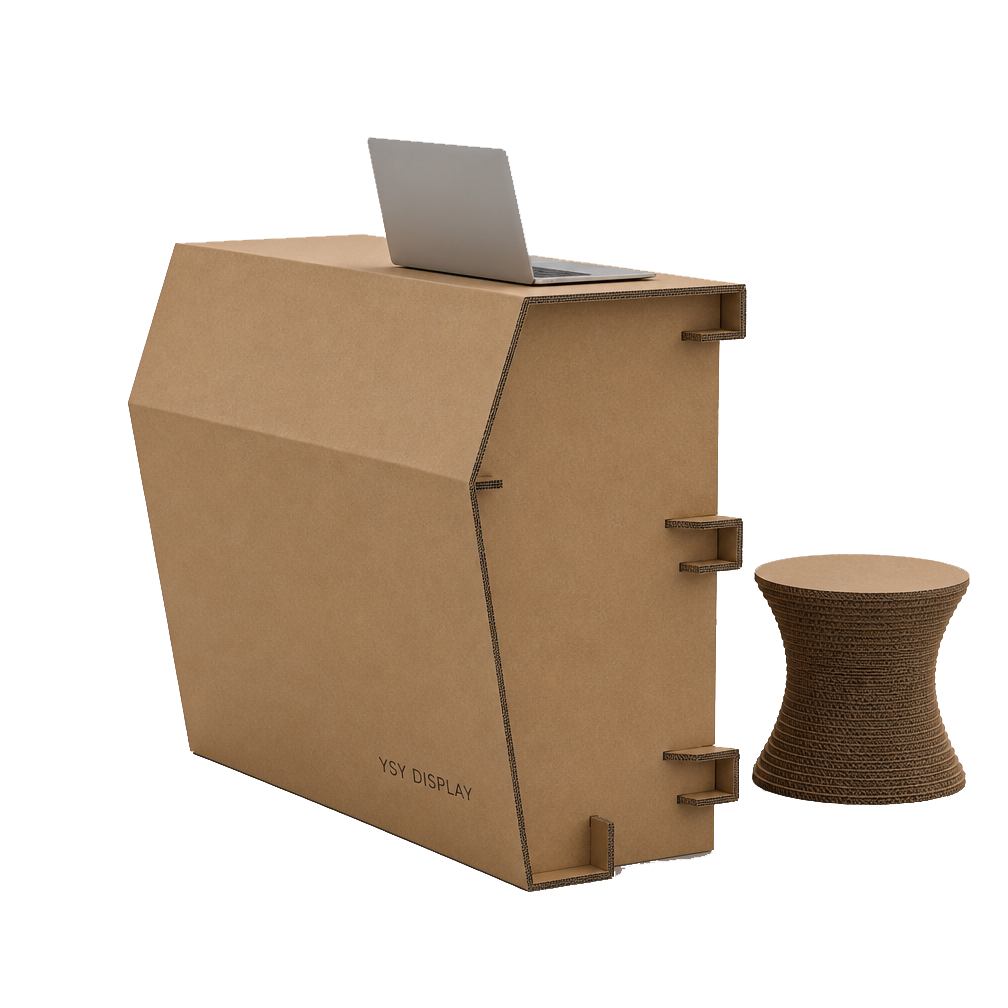
What Is Cardboard Storage Furniture?
Cardboard storage furniture refers to functional storage and workspace solutions engineered from corrugated cardboard — specifically multi-layer or honeycomb board structures built to carry real product loads, resist lateral force, and support repeated use in retail and commercial environments. The structural core is a corrugated honeycomb board where flat liner sheets bond with a wave-shaped fluted medium, creating both lateral stiffness and vertical load-bearing capacity that makes it viable beyond decorative applications.
For B2B buyers evaluating display and storage options, cardboard storage furniture occupies a distinct position: lighter and more freight-efficient than wood or metal, quick to assemble without tools, and aligned with sustainability requirements that European and North American retail partners increasingly enforce. The sourcing question is rarely whether corrugated cardboard can work structurally — it is which board grade, flute configuration, and surface treatment best matches the deployment environment and compliance requirements.
Key Product Characteristics
-
Corrugated Honeycomb Construction: Flat liner sheets bonded with a wave-shaped fluted medium distribute vertical load across a wider cross-section than solid panel formats, making corrugated honeycomb board practical for shelving units, drawer organizers, and freestanding display systems that must support product weight during retail deployment.
-
Tool-Free Assembly: Cardboard storage furniture systems are engineered for flat-pack shipping and slot-and-tab assembly, allowing retail staff to set up displays without tools or specialist training. If your deployment spans multiple retail locations with limited on-site support, tool-free assembly reduces both setup time and the risk of structural errors during installation.
-
Material Certification Support: For shipments destined for European or North American markets, FSC-certified board material addresses chain-of-custody documentation requirements that corporate procurement policies and retail chain compliance teams increasingly request. ISO 9001 quality management certification supports production consistency expectations across bulk orders.
-
Flat-Pack Logistics Efficiency: The corrugated cardboard format enables significant volume reduction for sea and air freight — a meaningful factor when calculating total landed cost for cross-border shipments. It is easy to underestimate how freight cost contributes to the program total when a production quote does not include a realistic logistics estimate for the destination market.
-
Printable Surface for Brand Integration: Corrugated liner surfaces support direct print application, enabling brand-matched color, graphic, and messaging on the structural component itself. This dual function — product containment and brand communication — is a primary reason retail brands select cardboard storage furniture for promotional and seasonal campaign environments.
Common Applications
Cardboard storage furniture is used across retail, commercial, and event environments where quick deployment, lightweight logistics, and recyclable material credentials deliver operational value:
-
Retail Clothing Display: In fashion retail environments, corrugated shelving units and wall-mounted storage solutions provide a recyclable alternative to permanent fixtures for seasonal campaigns where the display needs to be set up quickly and removed cleanly at campaign end.
-
Freestanding Slatwall Display: Cardboard panels configured with slatwall-style surface detailing support hanging product presentation in retail environments — useful for brand activations that require a freestanding slatwall display without the cost and logistics of a metal or MDF unit.
-
Retail Hat Rack and Accessories Display: Lightweight product categories like hats, scarves, and accessories are well matched to corrugated furniture whose load capacity suits light hanging product weight while offering faster setup than traditional retail hat rack formats.
-
Leaflet Stand and Literature Display: Multi-compartment cardboard units configured as leaflet stands are standard in retail entry points, event environments, and brand activation zones where a structured but cost-efficient support format for printed materials is needed.
-
Trade Show and Brand Activation: Flat-pack portability, tool-free setup, and end-of-event recyclability make cardboard storage furniture a practical choice for trade show booth configurations and pop-up brand activations where both display logistics and waste disposal are operational constraints.
How to Choose the Right Cardboard Storage Furniture
When evaluating cardboard storage furniture suppliers for B2B procurement, the criteria that determine deployment success go beyond unit price and surface appearance. A structured evaluation approach helps identify the right specification:
-
Define Load and Duration Requirements First: What is harder to predict before deployment is how a cardboard shelving unit or floor display holds up when stocked with the actual product weight — particularly after two to three weeks in a warm or humid retail environment. Clarify maximum product weight per shelf, expected display duration, and whether the environment presents humidity exposure risk before specifying a board grade and flute configuration.
-
Confirm Assembly Documentation: If the display will be assembled by retail staff without dedicated training — for example, in a multi-location national rollout where on-site supervision is not feasible — confirm that the supplier provides clear, illustrated assembly instructions and that the structure uses unambiguous slot-and-tab connections. Assembly instruction clarity is a frequently overlooked factor that becomes critical when displays are damaged or incorrectly assembled during high-traffic deployment.
-
Review Certification Documentation Early: For EU or North American market deliveries, confirm that the supplier can provide FSC chain-of-custody documentation and ISO quality management certificates that satisfy corporate procurement approval or retail chain onboarding requirements. Buyers who discover certification gaps at the import stage face compliance delays that compress an already tight campaign timeline.
-
Evaluate Custom Print Capability Against Sustainability Goals: Choosing recycled or uncoated cardboard for a display that carries brand-critical graphics aligns with sustainability messaging, but requires accepting that print vibrancy and surface durability trade off against recyclability — a trade-off worth naming explicitly during supplier evaluation rather than discovering after first delivery.
-
Plan Realistic Lead Times: Production time alone does not account for graphic approval rounds, export document preparation, and freight consolidation. For cross-border shipments from China to European or North American destinations, plan sufficient buffer to avoid a display arriving after its deployment window has opened.
Sustainability Positioning and Procurement Realities
Environmental and sustainability pressures are increasingly influencing display material decisions, particularly in European markets where EU packaging regulations and brand ESG commitments are driving preference toward recyclable, reduced-plastic, and responsibly sourced display materials. Corrugated cardboard storage furniture supports this positioning — offering recyclability, lower manufacturing carbon footprint, and end-of-life material recovery that satisfies the sustainability messaging requirements of eco-conscious brand buyers.
A balanced evaluation, however, acknowledges that cardboard furniture exposed to heavy product loading or extended campaign duration without appropriate structural grading will underperform. The sustainability case for cardboard storage furniture is strongest when the product specification is matched to actual deployment conditions rather than selected on material credentials alone. For buyers managing multi-location campaign programs, cardboard display reorder cycles tend to be shorter and more frequent than permanent fixture alternatives — typically campaign-by-campaign — making supplier quality consistency and documentation readiness for repeat import clearances ongoing procurement requirements, not just first-order considerations.
Why Source from a Specialized International Manufacturer
For B2B buyers sourcing cardboard storage furniture for European, North American, or Middle Eastern deployments, working with a manufacturer experienced in serving these markets reduces procurement friction at each stage — from specification alignment and sample review through export documentation, freight planning, and post-delivery support. Suppliers with established export capabilities in target markets understand the quality standards, certification documentation requirements, and lead time expectations that retail chain buyers and brand compliance teams enforce.
For reference, industry performance standards for structural cardboard products — covering categories such as load-bearing capacity, flat-pack compression strength, and print durability — exist as documented benchmarks. Specific standard numbers should be confirmed with the supplier's quality documentation or a qualified engineer before citing them in procurement specifications or compliance submissions.

 EN