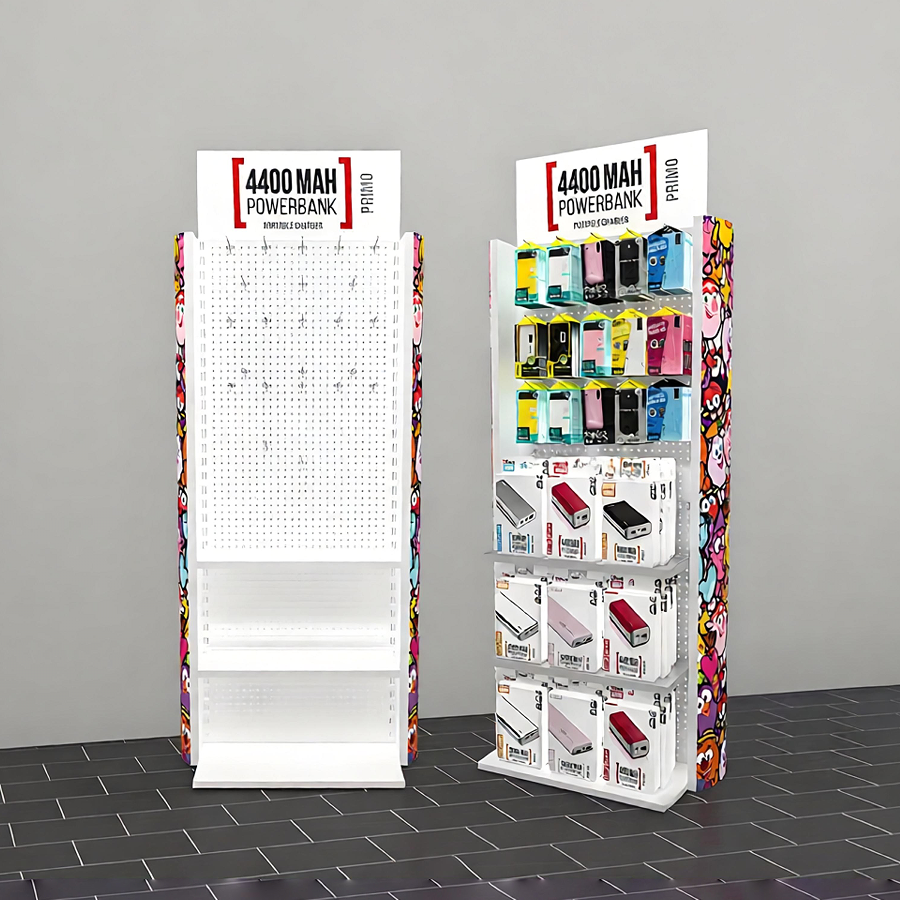
What Are Phone Accessory Displays?
Phone accessory displays are purpose-built retail fixtures designed to present mobile phone cases, screen protectors, chargers, cables, and related accessories in an organized, visually accessible format. From a visual merchandising perspective, the way phone accessory displays are deployed in a retail environment directly affects shopper dwell time — meaning how long a customer engages with the product section before making a purchase decision — and overall conversion at the point of sale. Unlike general-purpose shelving, phone accessory displays are engineered to satisfy a dual requirement: structural product containment and brand communication must be achieved at the same time.
This category of phone accessory displays covers the full range of available formats: wall-mounted slatwall and pegboard systems, rotating floor stands, glass showcase cabinets, gondola-style floor displays, and countertop units. Each format is suited to a different retail context, customer interaction model, and space utilization objective. Buyers sourcing phone accessory displays for European and North American markets typically expect suppliers to understand the planogram compliance standards, quality documentation requirements, and lead time expectations of these regions — these are not optional features but baseline considerations for retail chain supply programs.
Key Product Characteristics of Phone Accessory Displays
-
Format Variety: Phone accessory displays are available in wall rack, rotating floor stand, glass showcase cabinet, gondola, and countertop configurations. Each differs in floor footprint, product capacity, and visual impact on the retail floor.
-
Material Options: Common materials include acrylic, powder-coated metal wire, tempered glass, and steel tubing. Material selection affects structural durability, brand aesthetics, and freight weight — all of which feed into total program cost calculations for international buyers sourcing phone accessory displays.
-
Lighting Integration: Integrated LED strip lighting built into shelf edges or frame channels improves product visibility in ambient retail environments. The dwell time in a display section is directly affected by whether the lighting arrangement guides the shopper's eye to the product zone rather than creating undifferentiated brightness.
-
Security Features: Lockable glass panels and enclosed cabinet configurations address security requirements for higher-value accessories such as branded cables and wireless charging pads. If your priority is controlled customer interaction over open browsability, enclosed phone accessory displays with lock mechanisms are the practical choice.
-
Customization Scope: Display product customization is the norm for retail brand buyers. Logo printing, brand-color matching, custom footprint dimensions, and structural modifications are standard requirements — standard catalog units rarely satisfy all brand identity and planogram compliance needs without modification when sourcing phone accessory displays.
-
Surface Treatments: Scratch-resistant and anti-static surface treatments on acrylic phone accessory displays reduce maintenance burden in high-traffic retail environments and are baseline expectations for retail chain deployments in European and North American markets.
Common Applications for Phone Accessory Displays
Phone accessory displays are deployed across a range of retail environments, each with different space, security, and brand presentation requirements:
-
Mobile Carrier Stores: Wall-mounted slatwall panels and modular gondola systems support high SKU counts and frequent product rotation in carrier retail environments. Multi-level configurations maximize floor space utilization in locations with limited square footage.
-
Electronics Boutiques and Specialty Retailers: Glass showcase cabinets and custom-printed acrylic countertop units support premium brand positioning and enable controlled customer interaction for higher-value accessories.
-
Shopping Mall Kiosks: Compact 360-degree rotating floor stands and tiered countertop towers maximize product exposure within a constrained footprint, allowing multiple customer touchpoints around a single unit.
-
Multi-Brand Retail Chains: Standardized slatwall wall systems and branded gondola units support planogram compliance programs across multiple store locations, where visual consistency across the network is a brand requirement.
-
Pop-Up Retail and Brand Activation Events: Lightweight modular phone accessory displays that assemble without tools support temporary retail activations and brand events where deployment speed and transport efficiency are priorities.
In practice, the effectiveness of phone accessory displays in a retail setting depends heavily on their position relative to the natural shopper path — a detail that is easy to miss when evaluating display options in isolation. A rotating floor stand placed at a traffic pinch point will consistently outperform a premium wall installation positioned behind the main customer flow, regardless of the quality difference between them.
How to Choose Phone Accessory Displays for Your Retail Environment
Selecting the right phone accessory displays for your retail environment involves more than choosing the most popular format. The following framework walks through the key decision points for buyers evaluating phone accessory displays for carrier stores, kiosks, and brand retail programs:
-
Define Your Use Environment First: A carrier store managing 200 or more SKUs has fundamentally different requirements than a boutique kiosk presenting 20 curated accessories. High-traffic open browsing environments favor accessible rotating stands and slatwall systems; security-sensitive premium retail environments favor lockable glass cabinets and acrylic enclosures.
-
Map Product Volume and Rotation Frequency: If your display program involves frequent product changes across multiple store locations, modular slatwall and hook-based phone accessory displays with interchangeable panels typically offer better long-term value than fixed shelf configurations. If the product range is stable and presentation quality is the primary driver, glass and acrylic formats deliver a stronger brand impression.
-
Confirm Dimensions Against Retail Space Specifications Early: Actual dimensions for phone accessory displays often differ from initial supplier quotes — display units that do not fit the intended retail planogram slot or floor clearance create costly deployment problems. Request a full technical drawing with assembled dimensions and confirm against your retail space specifications before approving production.
-
Shortlist Materials Based on Durability and Brand Requirements: Acrylic is suited to countertop and premium brand presentation; powder-coated steel is preferred for floor-standing high-traffic units; tempered glass suits enclosed showcase applications. If your trade show appearances are frequent and phone accessory displays handle repeated assembly cycles, a rigid acrylic or metal structure usually justifies the investment. If the deployment is a short-term promotional activation, a well-engineered modular stand serves the objective without over-investment.
-
Plan Production and Shipping Timelines Realistically: It is easy to underestimate lead time for custom phone accessory displays when a supplier quotes a standard production window — that window often does not account for graphic approval rounds, sample revision cycles, freight consolidation at the origin port, and customs clearance at destination. For buyers shipping to Europe or North America, building an additional two to three weeks into the planning timeline is a practical risk-reduction measure.
Why Phone Accessory Display Quality Matters for International Brand Buyers
For brands operating retail programs across European and North American markets, phone accessory displays are evaluated at two levels simultaneously: structural integrity under retail deployment conditions and brand presentation standards at the point of customer contact. A unit that holds product reliably but delivers uneven print colors, mismatched surface finishes, or inconsistent edge quality creates a brand compliance failure at the moment of deployment — when replacement is costly and time pressure is highest.
Buyers who source phone accessory displays internationally sometimes find that edge chipping or surface scratching on acrylic components is a packaging problem rather than a manufacturing defect — but the practical consequence, replacement cost and delayed retail launch, is the same. Confirming packaging specifications for fragile display components is a straightforward step that reduces arrival damage risk without meaningfully increasing order cost.
For buyers managing phone accessory displays across multiple retail locations or coordinating brand rollouts in European and North American markets, a supplier with direct experience serving these regions understands the quality documentation standards, regulatory requirements, and production consistency expectations without requiring detailed education from the buyer. Customization capability — covering logo printing, custom sizing, brand-color matching, and structural modification — is a core service expectation for this buyer profile, not a special request that carries a premium. Both standard and fully custom phone accessory displays are available through experienced display manufacturers who serve international retail supply programs.

 EN