What Are Hook-Style Cardboard Racks?
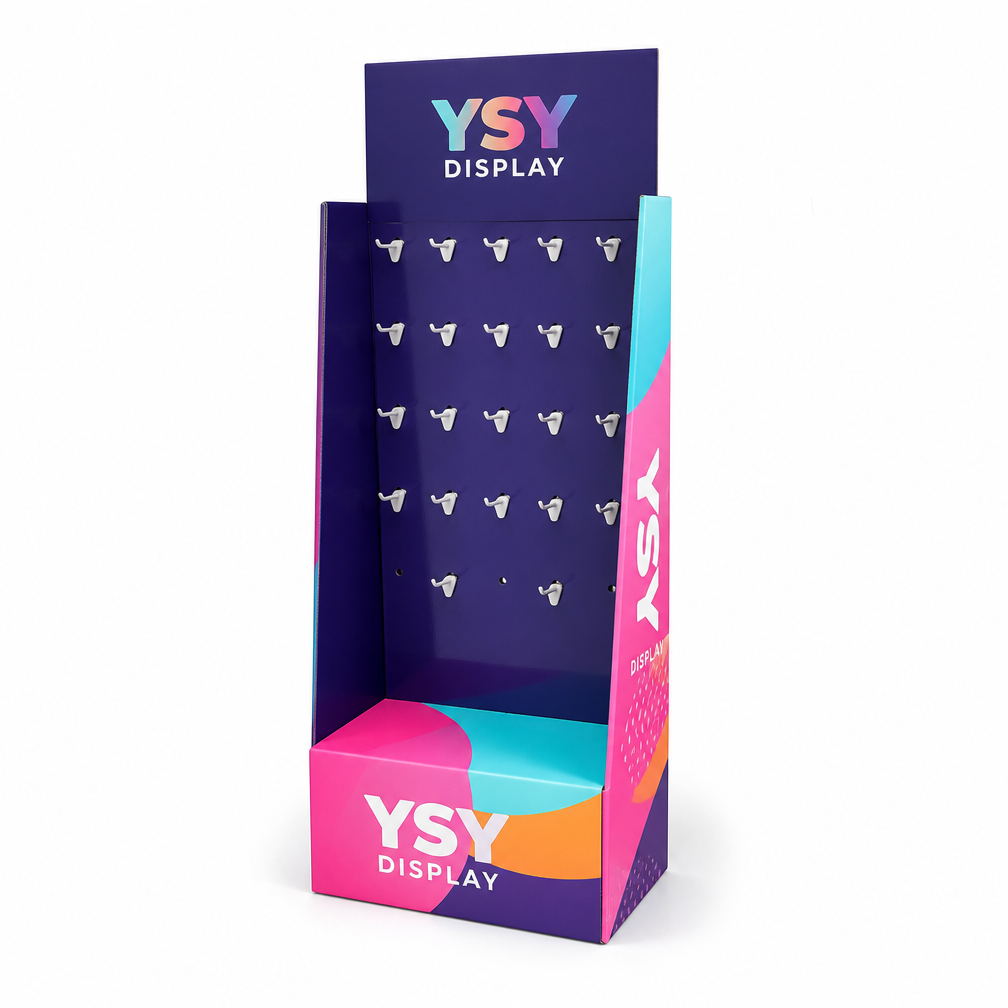
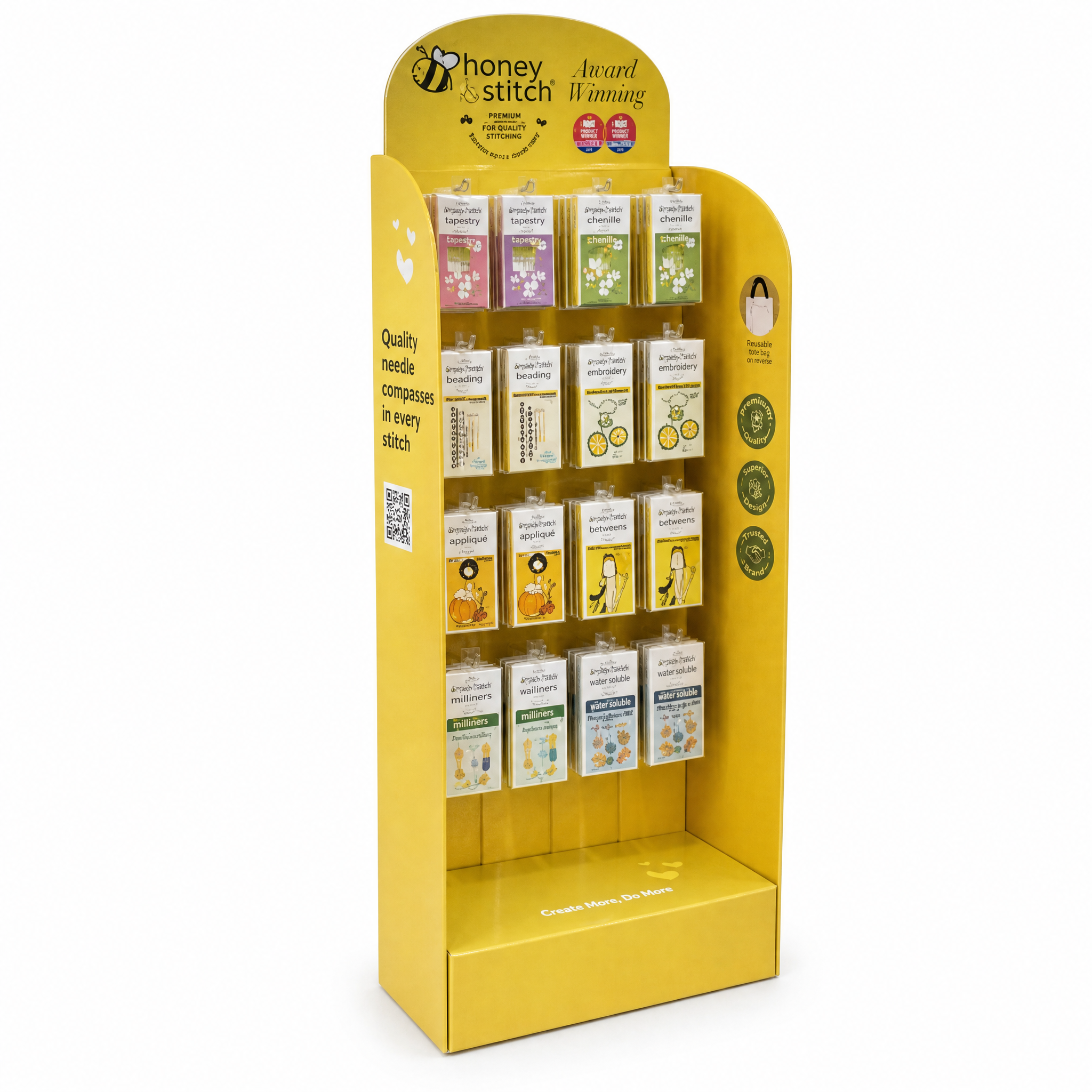
Hook-style cardboard racks are corrugated display units fitted with multiple metal peg hooks, designed to present hanging merchandise in a three-dimensional format. Unlike flat shelf displays, these units hold products vertically, making each item easy to browse from multiple angles while using vertical retail space efficiently. Typically constructed from die-cut corrugated board with folded structural panels and pre-punched hook attachment points, hook-style cardboard racks offer a practical balance of structural function and campaign flexibility — provided buyers choose the right configuration for their specific load and environment.
Key Product Characteristics
Hook-style cardboard racks are built around several configurable components that determine suitability for a given retail program:
-
Metal Peg Hooks: Pre-mounted metal hooks allow individual product units to hang at consistent spacing. Hook count, spacing, and weight capacity should be matched to product packaging weight and hanging hole position to prevent product drop or instability during retail operation.
-
Foldable Corrugated Structure: Hook-style cardboard racks fold flat for shipping and unfold for on-site assembly, reducing freight volume considerably compared to pre-assembled metal fixtures and simplifying logistics for multi-location campaign rollouts.
-
Custom Logo Printing: Full-surface printing supports brand logos, promotional messaging, and campaign graphics. Display product customization is the norm — most brand buyers require branded or structurally modified products rather than catalog items, and the corrugated hook format accommodates this through full-panel print coverage across all visible surfaces.
-
Flexible Hook Count and Sizing: The number of hooks, the number of tiers, and the overall dimensions of hook-style cardboard racks are configurable to match product SKU count and retail floor space allocation.
-
Custom Color Options: Base board color and printed graphic panels can be matched to brand identity requirements. For campaigns requiring consistent color across multiple retail locations, Pantone-referencing at the specification stage reduces color variation between production batches.
Common Applications
Hook-style cardboard racks are deployed across a wide range of retail and point-of-purchase environments. Typical merchandise categories include batteries, hardware and tools, toys, kitchen utensils, shoe accessories, hats, scarves, socks, confectionery, and packaged consumer goods. The display format performs well in supermarkets, convenience stores, specialty retail stores, and promotional POP setups — wherever accessible, browsable product presentation is needed without a permanent fixture investment.
Hook-style cardboard racks are particularly effective when product packaging already includes standard hanging holes (meaning the Euro hook slot or a compatible punched opening in the card or blister pack). If product packaging does not have a compatible hanging format, aligning packaging and rack specifications in the same supplier brief before sampling begins is strongly advisable to avoid dimensional misalignment after bulk production.
Brands frequently deploy this display format for temporary campaign programs, seasonal product launches, and promotional floor displays. Reorder cycles are shorter and more frequent than for metal or acrylic alternatives — many brand buyers reorder campaign-by-campaign, making supplier quality consistency across multiple short-cycle orders a key evaluation factor when sourcing hook-style cardboard racks.
How to Choose Hook-Style Cardboard Racks for Your Program
Selecting the right hook-style cardboard racks for a campaign requires evaluating several interdependent factors in sequence. The following step-by-step approach covers the key decision points in priority order:
-
Define the Deployment Environment: Confirm whether hook-style cardboard racks will be used on a retail floor or counter, in an indoor or semi-outdoor setting, and what the ambient humidity level is. What is harder to predict before deployment is how these racks hold up when loaded with heavier product SKUs — particularly after two to three weeks in a warm or humid retail environment. For heavier products or elevated humidity, specify a higher-grade corrugated board and request a load-bearing confirmation during sample review.
-
Match Hook Specifications to Product Weight: Confirm hook weight capacity against your product hanging weight. Hooks not adequately matched to product weight are a common procurement oversight — address this explicitly in your specification brief before sampling to avoid structural issues at deployment.
-
Confirm Product Packaging Compatibility: Verify that your packaging includes correctly positioned hanging holes before placing a rack order. Where possible, align both rack and packaging specifications in the same brief to prevent misalignment between hook position and hanging hole placement.
-
Specify Customization Requirements Before Sampling: Logo placement, print dimensions, structure dimensions, tier spacing, and hook count should all be defined in the design brief before the sample stage. If your campaign requires precise color consistency across multiple retail locations, include Pantone references — and if color accuracy is brand-critical, request a printed proof panel before bulk production is approved.
-
Plan Lead Time Realistically: It is easy to underestimate lead time for hook-style cardboard racks when a supplier quotes a standard production window — that window often does not account for design confirmation rounds, printing approval steps, and freight consolidation before delivery. Build at least two to three additional weeks into your campaign timeline beyond the quoted production lead time, especially for first-time orders.
Procurement Considerations for B2B Buyers
When evaluating suppliers for this display format, the key consideration areas include: hook load capacity relative to product weight, product packaging compatibility, tier and hook count configuration, visual brand impact through custom printing, and whether combination formats — floor displays with hook tiers or counter units with hook extension panels — can be supported within the same production run.
Display quality consistency between the approved sample and the bulk production run is a recurring concern. Print color shifts, structural deformation under product load, or hooks that do not fit the specified attachment points are issues more effectively addressed at the sample review stage than after bulk delivery. A thorough sample review under actual product load conditions reduces deployment-stage quality surprises for these racks.
Suppliers with structural design knowledge covering load distribution, assembly ease, and retail floor stability can reduce the revision rounds required before sample approval, particularly for buyers without in-house display engineering resources. Customization support across logo printing, sizing, and structural modification allows these display units to be adapted to non-standard product dimensions or retailer-specific planogram requirements.
Summary
Hook-style cardboard racks are a versatile, campaign-deployable display format suited to a wide range of hanging merchandise categories in retail and point-of-purchase environments. Effective procurement requires aligning hook specifications to product weight and packaging compatibility, planning campaign timelines to account for realistic lead time beyond the quoted production window, and requesting structural performance confirmation for heavier loads or challenging deployment conditions. Suppliers who support full customization and maintain production quality consistency from sample to bulk order reduce the total procurement effort across multi-cycle campaigns. Request samples before committing to bulk production, and use the sample review stage to validate structural behavior under actual load conditions as well as print accuracy against your brand references.
 EN