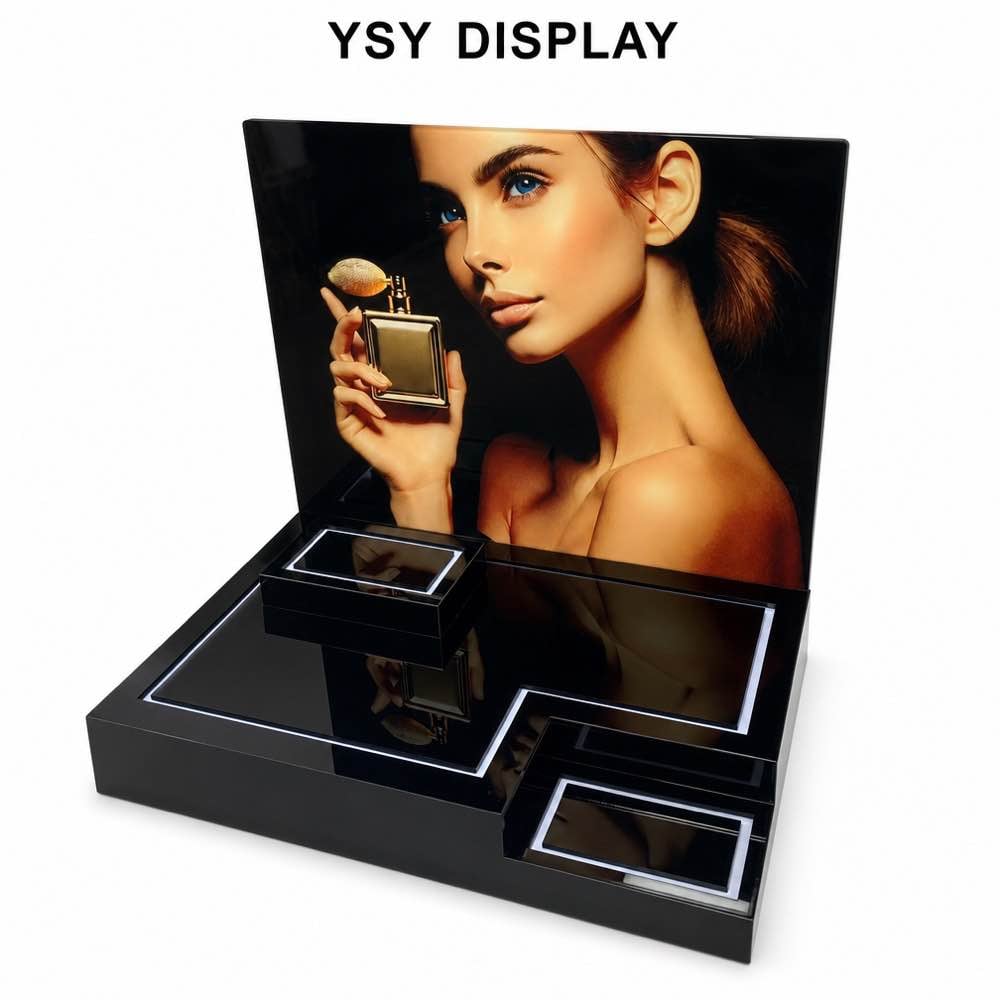
What Are Cosmetic Acrylic Displays?
Cosmetic acrylic displays are transparent or tinted display units made from cast or extruded acrylic — a material also referred to as PMMA or Plexiglas — designed to present beauty and personal care products in retail and professional environments. From lipstick towers and foundation stands to perfume risers and skincare tiered trays, cosmetic acrylic displays combine the structural clarity of glass with the workability and safety of plastic, making them a default choice for beauty retail buyers who need high-visibility product presentation without the fragility of glass.
For brand buyers sourcing cosmetic acrylic displays for European or North American retail programs, the format serves a dual function: it contains and organizes product, and it communicates brand quality through its finish, color, and structural precision. A cosmetic acrylic display that looks degraded — scratched surfaces, visible glue marks, or uneven polish — directly affects the brand impression at point of sale. This is why material selection and fabrication quality deserve more attention than they often receive at the initial sourcing stage.
Key Characteristics of Cosmetic Acrylic Displays
-
Optical clarity: High-grade acrylic transmits light in a way that makes products appear prominently without distortion. This is a practical factor for cosmetic acrylic displays used at countertops where visual impact directly influences shopper dwell time (meaning how long a customer spends evaluating a product before picking it up) and purchase intent.
-
Surface finish options: Cosmetic acrylic displays can be produced with a glossy polish, matte finish, or frosted texture depending on the brand aesthetic. Edge polishing quality — particularly the consistency of cut edges and bonded joints — determines whether the display reads as premium or budget under the focused LED lighting typical of modern cosmetics retail environments.
-
Customization as standard: Unlike some display materials that require significant tooling investment for modifications, acrylic can be cut, bent, and bonded into custom forms with manageable lead times. Logo printing, color tinting, and size modification are standard requests when sourcing cosmetic acrylic displays for branded retail programs rather than premium exceptions — most brand-aligned programs require at least partial customization to match specific counter dimensions and planogram specifications.
-
Structural durability in context: Cosmetic acrylic displays resist impact better than glass at comparable weights, but thicker acrylic does not necessarily mean more durable across all retail scenarios. What determines long-term structural performance is the material grade including UV stabilizer content, the quality of bending and bonding operations, and how well packaging protects the cosmetic acrylic display during international freight — not surface thickness alone. Buyers who default to thickness as a durability indicator frequently discover this after the first reorder cycle.
-
Weight advantage for logistics: Cosmetic acrylic displays are significantly lighter than glass equivalents, which reduces per-unit shipping cost and makes restocking manageable for retail staff who reposition countertop displays frequently in active beauty retail environments.
Common Applications for Cosmetic Acrylic Displays
Cosmetic acrylic displays are deployed across a wide range of retail and professional settings, each with distinct requirements for size, structure, and finish quality:
-
Beauty retail counters: Countertop risers, tiered trays, and lipstick holders represent the most frequently sourced cosmetic acrylic display formats for specialty cosmetics retailers and department store beauty counters. In these environments, display surfaces are handled frequently by both staff and shoppers, making scratch resistance and surface coating quality a practical priority rather than a cosmetic preference.
-
Perfume and skincare boutiques: Freestanding towers, wall-mounted units, and multi-level pedestals present premium product lines in luxury retail settings. Acrylic bonding or joint areas with visible glue marks, bubbles, or misalignment are typically only apparent under display lighting or at close inspection range — which is exactly the viewing distance a shopper in a premium boutique applies to every cosmetic acrylic display surface they encounter.
-
Nail and hair salons: Countertop organizers and product display racks in professional beauty service environments require compact formats and easy surface cleaning. Acrylic's non-porous surface suits this use case for both hygiene and maintenance reasons.
-
Trade show booths and brand activations: Lightweight, high-clarity cosmetic acrylic displays are regularly used at beauty trade shows where visual impact must be achieved with manageable transport weight and straightforward setup. If your trade show schedule is frequent and the cosmetic acrylic display sees significant handling between events, the investment in a rigid, well-structured acrylic format typically pays back in reduced replacement frequency. Buyers who source acrylic display stands for international trade show programs often find that edge chipping and surface scratching is a packaging failure, not a product quality failure — but the result on arrival is the same regardless of the cause.
-
E-commerce product staging: Cosmetic acrylic displays in riser, tray, and stand formats are widely used as photography surfaces and presentation props for beauty brands, where the material's glossy or non-reflective properties complement cosmetics product imagery for online retail channels.
How to Choose Cosmetic Acrylic Displays for Your Retail Program
Selecting cosmetic acrylic displays for a retail program or brand campaign involves more decision variables than a standard product search suggests. The following steps outline the sequence that most experienced brand procurement teams follow — though not every step applies with equal weight to every situation.
-
Define the deployment environment and display lifespan: If the cosmetic acrylic display will be used as a permanent counter fixture intended for multi-year use, material grade, UV resistance, and structural design all deserve more detailed specification than for a seasonal promotional campaign. If your program has a fixed campaign end date, a well-made standard format may perform adequately without the additional cost of a fully custom structure.
-
Establish dimensional requirements before quoting: Most brand-aligned cosmetic acrylic display programs require custom sizing to match specific counter depths, product SKU dimensions, and retailer planogram specifications. Standard catalog sizes are useful for sampling or low-urgency procurement, but dimensional tolerance requirements should be confirmed before bulk production begins. Variance between units becomes visible when cosmetic acrylic displays are deployed at scale across multi-location retail rollouts.
-
Evaluate surface finish and joint quality through samples: Request a physical sample before committing to bulk production and review it under the same lighting conditions your retail environment uses. A cosmetic acrylic display that looks clean under diffuse office light may show surface haze, joint inconsistency, or polish variation under the focused LED lighting used in most contemporary cosmetics retail. This review step is where fabrication quality becomes visible — and where sourcing decisions are often revised.
-
Confirm customization scope and production timeline: Logo printing, color tinting, and structural modifications each affect production lead time for cosmetic acrylic displays. For buyers in European and North American markets, realistic timeline planning should account for international production time, freight, customs clearance, and any pre-shipment quality inspection requirements. If a confirmed delivery date for a campaign launch is the priority, establish this timeline requirement explicitly with the supplier at the start of the procurement process.
-
Specify packaging protection as part of the order requirements: This step is consistently underweighted by first-time international acrylic display buyers. Acrylic is a fragile material category during transit, particularly for edge-finished and polished components. If the supplier's packaging specification does not include individual foam protection, corner guards, and intermediate layer separation, surface damage in transit will occur regardless of production quality. Packaging specification should be reviewed and confirmed during the sample approval process.
Sourcing Cosmetic Acrylic Displays for Brand Retail Programs
From a visual merchandising perspective, the way cosmetic acrylic displays are positioned at point of sale affects how shoppers engage with the product and how the brand is perceived before any product interaction occurs. A cosmetic acrylic display that presents skincare or color cosmetics in a clean, organized, and well-lit format reduces the friction of product evaluation and signals brand quality through its material and finish quality alone.
For brand buyers managing multi-location retail programs or annual campaign sourcing, the challenge with cosmetic acrylic displays is less about finding a product and more about maintaining consistency — in surface quality, dimensional accuracy, and delivery reliability across order cycles. Both the functional outcome and the sourcing process reward buyers who invest in supplier evaluation, sample review, and packaging specification early in the procurement process. These decisions are established before production begins, and adjusting them after the first bulk shipment is significantly more costly than getting them right at the sample stage.
Suppliers with documented experience serving European and North American brand buyers typically understand the quality standards, documentation requirements, and lead time expectations specific to these markets — which reduces the coordination burden for procurement teams managing cross-border sourcing of cosmetic acrylic displays for the first time or expanding their international display supply programs into new markets.
Whether the requirement is a single flagship counter installation or a multi-location retail chain program, the sourcing decisions that most affect the outcome — material specification, finish quality, packaging design, and supplier quality management — are all made before the first cosmetic acrylic display unit is produced.

 EN