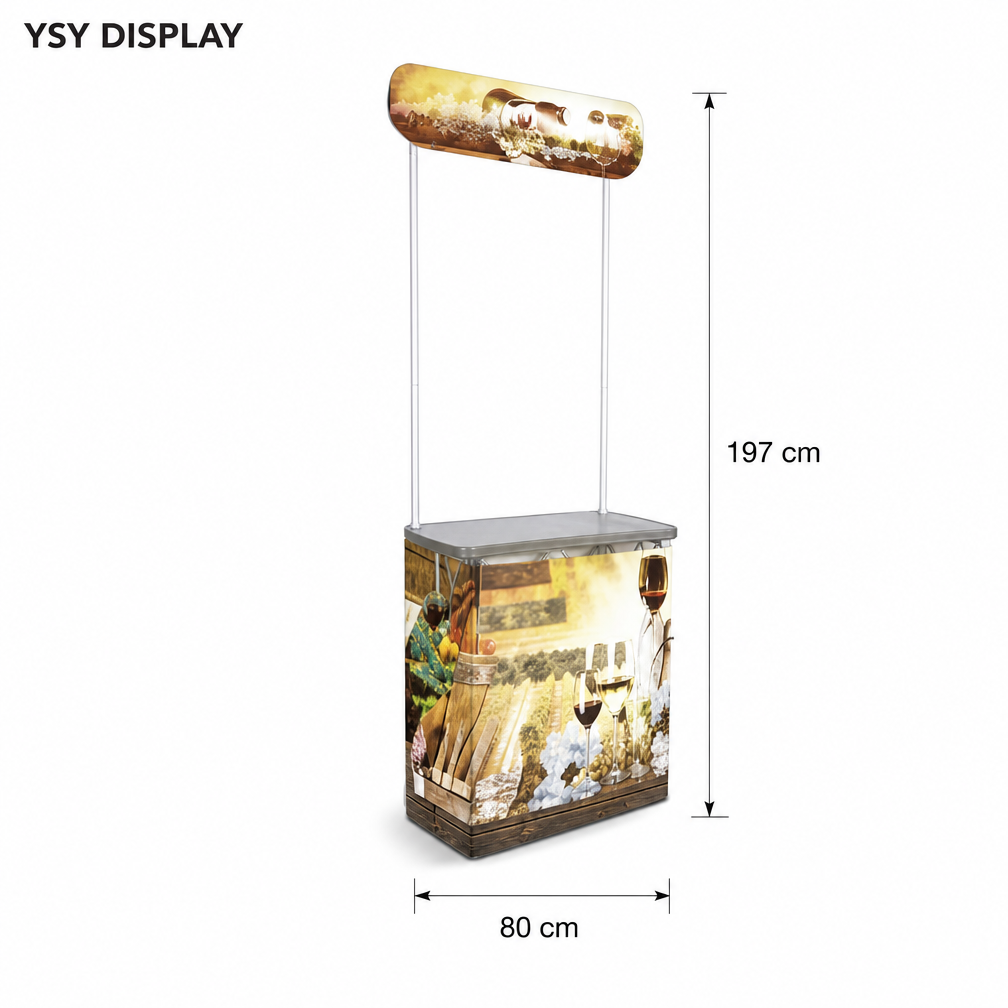
What Are Promotion Counters & Information Desks?
Promotion Counters & Information Desks are portable, branded display units built to give brands a professional, structured presence at trade shows, brand activation events, shopping mall promotions, and product launch campaigns. Unlike fixed commercial store fixtures installed once and maintained in place, Promotion Counters & Information Desks are engineered for repeated setup and breakdown — making them a core tool for brands that need a branded presence across multiple venues without committing to a permanent installation.
As a procurement specialist who has evaluated display materials across trade show environments and retail activation programs, I've seen the same gap appear repeatedly: buyers focus on the visual appearance of a unit and significantly less on how it performs under real deployment conditions — setup time, transport dimensions, graphic durability after multiple pack-and-repack cycles. That gap between what looks good in a product photo and what works efficiently in a live event environment is where most sourcing decisions either pay off or cost money to fix.
This category includes a range of formats: pop-up style counters with foldable panel systems, straight or curved information desk frames with custom-print wrap panels, height-adjustable models for different operator configurations, and LED-ready structures designed to integrate lighting for higher-impact brand presentations including custom faux neon sign-style visual treatments.
Key Product Characteristics of Promotion Counters & Information Desks
-
Aluminum alloy frame construction: Most professional-grade Promotion Counters & Information Desks use aluminum alloy tube frames for the combination of structural rigidity and low carry weight. A cross-mesh folding iron frame with aluminum alloy and PP/PVC composite materials delivers exhibition-grade stability while folding flat for transport without specialized freight handling.
-
Height-adjustable design: Adjustable-height configurations accommodate different operator heights, presentation styles, and venue requirements without requiring a separate product order for each setting.
-
Flat-pack and foldable construction: The value of flat-pack design is not just reduced shipping cost — it also determines whether a two-person event team can realistically carry, set up, and break down units without additional assistance. Units that pack into a standard carry bag significantly reduce logistics friction for brands participating in multiple events per year.
-
LED-ready structure: LED-compatible frames include cable management routing and structural mounting points for integrated lighting. For brands wanting to incorporate a custom faux neon sign-style visual element or backlit panel into their counter setup, LED-ready frames eliminate the need for separate mounting hardware.
-
Custom-print graphic panels: Full-color printed graphic wraps allow complete brand identity coverage across the visible counter surface. Panel replacement mechanisms in select configurations allow graphic swaps without replacing the structural frame, extending hardware life across multiple campaign cycles.
-
Countertop surface and internal storage: MDF and molded plastic countertop surfaces accommodate product sampling, literature placement, and point-of-sale materials. Internal shelf configurations provide storage for product stock and promotional materials during live deployment.
Common Applications
Buyers in comparable situations across trade show and retail activation programs deploy Promotion Counters & Information Desks in the following contexts:
- Trade shows and international exhibitions — the primary deployment context, where brands need a professional branded presence within a defined booth footprint
- Brand activation roadshows and multi-city campaign tours, where the same unit is transported between venues
- Shopping mall and retail promotion stations, including seasonal campaign setups alongside existing commercial store fixtures installations
- Food and beverage sampling stations at retail, event, and hospitality venues
- Cosmetics and beauty brand in-store promotional counters
- Corporate reception desks, event registration points, and conference welcome stations
- Product launch events, press demonstrations, and showroom displays
How to Choose the Right Promotion Counters & Information Desks
The selection process comes down to a few dimensions that matter more in practice than most specification sheets suggest.
Before finalizing a counter design, it's worth thinking through how many people are needed to assemble it on-site — something that often gets overlooked during the design phase. Assembly instructions that appear clear in a controlled environment can become genuinely difficult to execute when a two-person team is setting up multiple Promotion Counters & Information Desks in a 45-minute window before a trade show hall opens. Clear, tool-free assembly is a procurement criterion worth verifying at the sample stage.
Pack-down dimensions and transport mode: The folded carry bag dimensions and unit weight directly determine whether a unit can travel by standard checked baggage, road freight, or requires palletized air freight. The physical dimensions of display products — weight, folded size, assembled footprint — directly affect freight cost and retail space planning, making them functional purchasing criteria. Confirming these numbers before ordering, rather than assuming from visual references, is a step that experienced procurement specialists build into their supplier evaluation process.
Temporary use vs. durable investment: The display industry serves both temporary-use (one campaign) and durable-use (multi-year fixture) buyer categories, with fundamentally different product requirements. A unit deployed at two or three events per year needs a different durability standard than one used at twelve or more events annually. Getting the durability tier right prevents under-investing in a unit that wears out mid-program or over-investing in capability a single-campaign deployment never requires.
Graphic update mechanism and shape options: Whether the unit supports graphic panel swaps without full replacement is a long-term program cost factor. Brands running seasonal campaign rotations benefit significantly from frames that accept graphic reloads without a new hardware order. Anyway, the point is — matching counter shape (straight, curved, or semicircular) to anticipated booth layout and traffic flow affects both visibility and staff movement around the unit.
Compatibility with existing commercial store fixtures: Buyers who already operate commercial store fixtures programs often source Promotion Counters & Information Desks as mobile complements to their fixed retail installations. Matching counter finish, color, and material specifications to existing commercial store fixtures maintains brand consistency between permanent in-store environments and temporary event deployments.
Lead Time and Procurement Planning
It's easy to underestimate lead time for custom-branded Promotion Counters & Information Desks when a supplier quotes a standard production time — the production window alone often doesn't account for graphic printing approval rounds, sample review, and freight consolidation delays. For event deployments with a fixed opening date, the full procurement timeline needs to include: sample sign-off, bulk production, quality inspection, export documentation, and freight transit. Starting the process 8–12 weeks before the event date is a common correction buyers make after experiencing a first-order delay.
If you're running a coordinated campaign that pairs promotion counters with other display formats — banner stands, literature racks, or custom faux neon sign installations — consolidating the order under a single supplier reduces freight coordination complexity and improves matched delivery timing for the full setup.
Why Promotion Counters & Information Desks Matter for B2B Buyers
Promotion Counters & Information Desks are the branded touchpoint where staff-customer interaction happens at trade shows, retail activations, and events. Whether it's a sampling station, registration desk, or product demo counter, the quality and appearance of this unit directly affects how the brand is perceived at the point of contact. Brands running multi-market programs — across European exhibitions, North American trade shows, and Middle Eastern retail activations — increasingly treat counter specifications as a brand standards item, not just a logistics procurement decision.
Customization capability — supporting logo printing, custom sizing, material selection, and structural design modification — is what separates a promotion counter program that maintains brand consistency from one that introduces visual inconsistencies across deployment markets. For buyers managing integrated brand environments, sourcing from a supplier with trade show display program experience and matching capabilities across both fixed commercial store fixtures and portable display formats reduces the overhead of managing multiple vendor relationships for a single brand environment.
 EN